
by The Embroidery Coach | | Embroidery Business Marketing, Embroidery Business Planning, Organizing
Bookkeeping is one of our least favorite things to do as embroiderers! We did not start our embroidery business so that we could do bookkeeping! We are born creators, not bookkeepers, but unfortunately, it is part of owning a business and is an essential part of the business that we must be on top of! You may feel like you are drowning in paperwork. Setting up a complete embroidery business bookkeeping system is essential in staying organized.
It is critical to organize every part of your business, and your records must be organized for easy and accurate bookkeeping. Without good record organization, it can become very overwhelming when you need to produce some important information, and it can cause unnecessary stress in your personal life and your business.
Have you spent many days just before filing your taxes trying to get everything organized? Trying to pull it all together at tax time when it is disorganized is really hard and time-consuming, not to mention how frustrating it can be. You could be spending this time getting more jobs out, but instead, you have to stop producing your embroidery and concentrate on the taxes in order to stay compliant with the government.
Your business generates a lot of paperwork and it can easily get out of control if you do not have a good system for taking care of it. This was a huge struggle for me until I realized that I could not continue to do it as I was and get my jobs out at the same time. I had to take some time out, stop the crazy disorganization of papers, and get my books in order.
Keeping accurate financial records is necessary for the growth of your business. You need to be able to look back and compare one year to the next so that you can plan more efficiently. You also need to know which area of your business is performing the best and in which area you are not making enough money. Without accurate records, this is impossible.
If you are new to bookkeeping and you have not started to use any type of accounting software you must first go through and organize all of your records. You must have them in order before you can even think about using any type of accounting software.
Start The Process of Organizing Your Bookkeeping Records for Your Embroidery Business Bookkeeping System Set Up!
Step 1- Separate the receipts for your expenses and for your income. Make sure that you have every little piece of paper because it can make a difference at tax time.
Step 2– Take the pile of receipts of your expenses and separate them by the month. Do the same for your income.
Step 3– Separate the piles of expenses and income for the first month into piles of like kinds.
Step 4– Create a spreadsheet with columns of the like kinds for your expenses and add the receipts into each column that is applicable. By like kinds I mean, Office supplies, loan payments, travel expenses, etc.
Step 5– When finished with the month, place the receipts into a file folder marked by the Month and place the file folder in a file drawer. Keep one file drawer for this purpose only.
Step 6– Repeat this process for your income statements.
Step 7– Total each column of expenses for the month. Do the same step for your income.
Step 8- Repeat this process on a separate spreadsheet for each month.
Organizing them in this manner will make it easier for you to start the process of working with accounting software. I know that the term accounting software is scary if this is all new to you, but it really is very simple to use once you have your expenses and income organized.
On February 13th and 14th, I am having an Embroidery Business Bookkeeping System Workshop where I will be showing you how to set up your entire bookkeeping system. This will be a 2-day workshop from 10:00 AM to 2:00PM Eastern. This is your chance to be able to get your entire system set up the correct way so that you will be able to see which area of your business is profitable and which area is not profitable.
I am using QuickBooks but this entire system works no matter what accounting or bookkeeping program you are using.
Click here to get signed up! Don’t hesitate to get signed up! We only have a limited amount that we can accept!

by The Embroidery Coach | | Embroidery Education
Many embroiderers find that embroidering Small Lettering is very challenging, but once you learn the basics, it is easier. In order to learn the basics, some key elements must be considered.
- Fabric
- Needles
- Thread
- Style of Lettering
- Underlay
The small lettering in the design, ONTARIO COUNTY, NEW YORK is only 3.6mm tall. This would not work well if it were upper and lowercase. It is best to keep lettering that small in all upper case letters. It also helps to use a plain block letter rather than one with serifs when you are embroidering lettering that small.
Making small lettering work to your satisfaction often means making adjustments to allow for your fabric type and the size and style of the lettering that the customer is requesting. Many times what they are requesting is not acceptable for embroidery. They are used to seeing their logos in type sets usually in ink or screen printing ink and this does not always work with needles and thread. It is not uncommon for a customer to request an unreasonable amount of letters all to be placed on one line.
With Small Lettering, you have to create a balance between the fabric, needles, thread, and the size and style of your lettering. You cannot have letters so small that you are creating stitches that will be stitching on top of each other. This causes holes in the fabric and thread breaks. Your stitch length must be a minimum of 1 millimeter in order for it to sew out properly and not create holes.
The size and type of needle that you are using is extremely important. If you are sewing on a knit fabric you must have a small ball point needle to be successful with small lettering. If your lettering is smaller than 4 mm, you must use a size 65/9 ballpoint needle and 60 weight thread. If it is 4mm or higher, you should be using a 70/10 ball point needle with your regular weight embroidery thread. This is especially important if it is on a performance knit. If you are working on a woven fabric, you will need a sharp needle instead of the ball point needle.
Embroidering Small Lettering is not hard when you learn the basics of each step. I created “3 Steps To Create Clean Small Lettering!” This is a simple step-by-step process PDF guide for only $27.00. Click Here to get started on your journey to creating great small lettering.
This is the perfect guide to print out and have handy to get your employees started in their journey to learning how to create small lettering. If the link does not work, copy and paste the complete address into the web browser.:
https://www.theembroiderycoachsystem.com/3-steps

by The Embroidery Coach | | Embroidery Business Marketing
Hi, I am Joyce Jagger, The Embroidery Coach and I started my business back in 1978 when a friend of mine asked me to Embroider names on some school jackets for him. When I finally got the job done, he was thrilled with it. There was no one in our area at the time that was doing embroidery, so I decided that this just might be a way that I could earn a few dollars and still stay at home.
Like so many other people that decide to start a business, I had big dreams of this being a business that was going to give me the freedom that I wanted, I could name my own hours, and make some extra money doing something that was enjoyable. It didn’t quite turn out that way, at least not at first.
This was the start of my home embroidery business that grew into a medium-size multi-head embroidery shop. Unfortunately, I learned everything the hard way and it was tough going. I spent many years struggling because I had no mentor and made many mistakes through it all.
I did not know how to price my embroidery, so I gathered the price lists from embroidery businesses all across the nation. These price lists were from large embroidery shops with many embroidery heads as well as small embroidery shops. I would average out what everyone was charging and create what I thought would be a good price. I had no idea that a large embroidery shop with many embroidery heads could charge less for the same design than a small shop with only a single head.
I was on a constant treadmill of running and running and never getting anywhere. Each month it seemed like I had less money to work with and more work was coming in. We were known for our outstanding quality and my business grew rapidly with repeat orders and by word of mouth. I was constantly borrowing money to purchase more equipment and be able to keep up with my payroll.
Our customer base was increasing and yet I was still struggling to make ends meet. This was a mystery to me. Why wasn’t I making some money. I was going further and further into debt and yet I was working night and day, 7 days a week trying to keep up with all of the work.
Then something happened that changed everything…
After 15 years of this nightmare, I finally went to my accountant and told him I just could not go on like this. I was tired of struggling and needed to stop this chaos. He told me that I needed to raise my prices and I was scared to death to do that because I would lose all of my customers. He flatly told me that either I raise my prices or go out of business. I had no idea how to do that. I thought that I had to be charging what the average embroiderer was charging, but I was so wrong.
He agreed to come into my shop and work with me for one solid week. He timed everything that everyone was doing and taught me how to keep track of each process and how to figure out what the cost was for each one. I was shocked when I learned that I was losing money on every single job that went out the door. He taught me how to create a price list that was profitable, and it is the same process that I teach today. He also taught me how to better organize my entire business and get it running more smoothly.
My whole life changed.
After 15 years of running night and day with no light at the end of the tunnel I had learned how to stop the chaos and start running my business like it should be run. After a few months, I totally turned my business around and started making money. I was able to go home at night with a clear head and enjoy my family. This is the way that it is supposed to be! With the right pricing structure, this can happen for you also.

by The Embroidery Coach | | Embroidery Business Marketing
This time of year is generally a bit slower, but for some, it is just another month that they have more work than they can handle. But some people need to bring in more customers.
Yesterday I sent out an email asking what your biggest issue is at this time of year and I had several responses like
- I am too busy; I wish it would slow down a little bit.
- I and buried and I need more help.
This is how it is for most of my high-level students.
Now for those that are not that busy, this would be a great time to join a networking group. They are all over the country and many of them are inexpensive to get started. Most all of them have a fee, but it is worth it
- What type of organization or clubs do you belong to?
- Are there organizations within your church that would be applicable to letting the people know what you do and that you are looking for more work? You can even start with a 15 or 20% discount for the month of February. This would not bring in a huge amount of income, but it could help you find more customers at a very low cost.
The local Chamber of Commerce would be good for most people to bring in more customers. When I had my large business, I joined the Chamber and was able to receive a lot of work from them and from other members of the Chamber.
You want to make sure you are always wearing an item that you can sell along with your logo on it. This is really important. People do not realize how important this is and what an impact it can make on those who view your work. Having our work on display can be a real boost to your business. I make sure that I wear my logo every place I go, including the gym. You would be surprised at how many people notice and start asking questions.
When you join, it is important to get involved and let people know what you do and how you can help them with their promotional needs. You need to promote your business in such a way that you are helping them promote theirs, not just tooting your horn about what you do. If you have high-quality clothing on with high-quality embroidery on it, that will speak for itself.
Hand out brochures selling your services, but do not add pricing to your brochure. You are only selling your business, not a particular product. I show you an example inside of the EmbroideryBusinessAcademy and even give you the template to use to make it easy to create your own brochure.
I hope that this gives you an idea as to how to get yourself in front of more prospects and bring in more customers.
Let me know how you currently are getting your name out there or getting your business in front of other prospects.
by The Embroidery Coach | | Embroidery Business Marketing
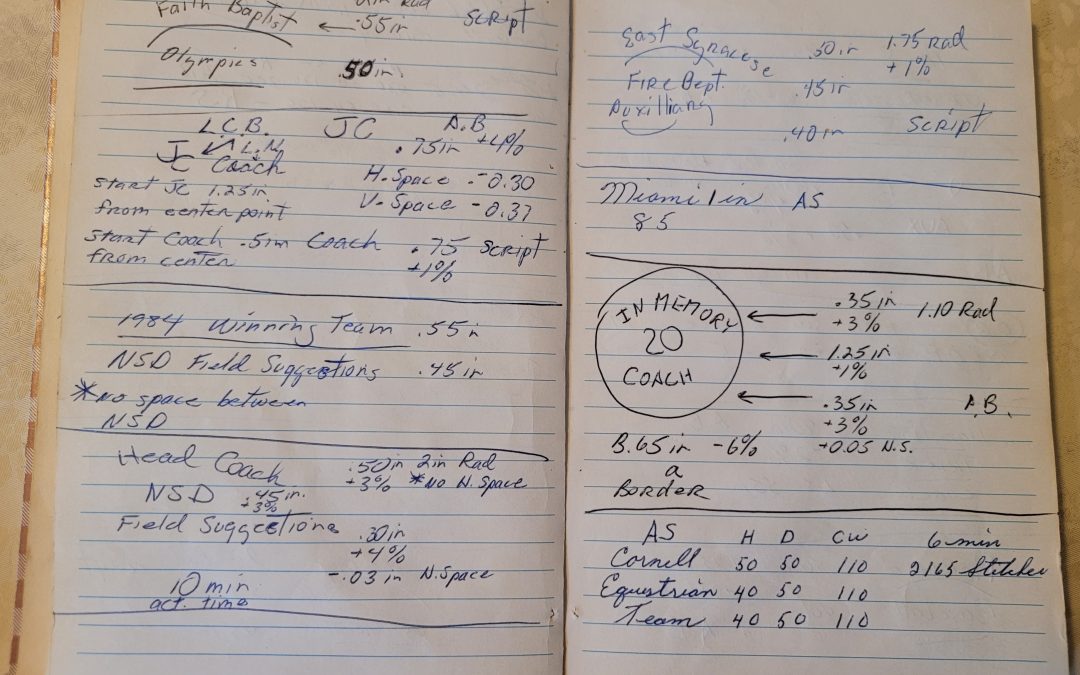
Do You Keep Track Of Your Embroidery Design Setups? When you are setting up your embroidery designs, do you keep track of what you did? Do you write down the settings that you added or do you think that you will remember them? It is very important to keep track of each one of your embroidery design setups.
I have found that thinking you will remember does not usually work. You have too many things rolling around in your head at the same time and when you go back and try to replicate what you did, it is very difficult to remember.
Way back in 1982 when I first started using design software, I started writing down everything about my embroidery design so that I could go back to it when I created another one similar to it or a repeat of what I had done. I had a simple little book that had the words on the front, Favorite Recipes. I had gotten it as a gift from someone for Christmas and instead of writing regular recipes down, I used it for my embroidery recipes. It worked out great.
I wrote words, added the customer’s name, and drew diagrams and little drawings to show exactly what I had done. I put in my settings, thread colors, sizes, and lettering styles. After I did a sewout and made some changes, I went back to my book and made the changes there.
You may want to start a system where you keep track of each embroidery design setup on your software design sewout sheet and then place that in a binder or in your catalog envelope with all of your information about that job or design that goes with a certain job.
The most important thing is that you need to start a system of keeping track of every one of your embroidery design setups or digitized designs that you do. This is very important and will save you a ton of time when you go back to that design or create another design using the same parameters.
Some people use recipe cards to keep track of their information and then file it inside of a recipe card file in alphabetical order. This works also. Whatever you decide to use, get a system started and start keeping track of each one of your embroidery design setups!
Joyce Jagger
The Embroidery Coach