by The Embroidery Coach | | Embroidery Education
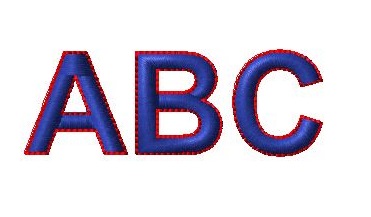
Here is a question that I received from one of my students. She needs some help creating outlines on Small Lettering the easy way! I thought that I would share it with my readers as this is a common problem.
Hi Joyce, hope you can give me some advice on lettering. Everybody wants OUTLINES. and I find them to be very problematic. I have seen them done with smaller lettering successfully, though so I don’t want to give up. I’m doing a 13mm lettering and every type of outline I use looks like a dotted line! I don’t want to do satin outline because I think it may be too heavy. Any advice?
Vicki, Creating an outline on a small letter can sometimes be very problematic; however, it is doable! Creating a satin stitch around a letter that is only one-half inch is very difficult. You will usually lose most of the inside area of your letter.
The run stitch outline looks good if you are using a dark colored thread. If you are using a light colored thread it looks terrible, at least that is my opinion. I have found that by digitizing a run stitch and going around the letter 2 times will make it look slightly better. Also, use a small stitch length such as 1.6 or 1.8 millimeters. Do not use the 2 ply as it will start and stop in the same place and you do not always have control over the start and stop point. It all depends on your software.
When you are creating outlines on small lettering the easy way, the best method is to digitize a single run stitch around your letter and then duplicate it. You can control the start and stop point if you are using this method. Another tip is to create the inside part of 2 or 3 letters at a time if you are doing a line of lettering. Then go back and create the outside part of these same 2 or 3 letters. Make sure that you put a lock at the beginning and at the end of this run segment. I always use line locks for my run stitches and connect each one of these letters. Do not lock and trim each letter individually, you may have many thread breaks or the thread may come out of the needle when you are starting up the embroidery machine. This is my favorite method of creating outlines on small lettering the easy way!
Vicki, I hope that helps you a bit!
by The Embroidery Coach | | Training Embroidery Employees
When your business is growing and you start to hire employees, it is very important that you stress upon the new employees the need to be able to work together as a team. If the new applicant is the type of person that gives you any indication that they will not be a team player then that is the wrong type of person to hire.
This week I had a situation with an embroidery business that has 12 employees and they are not growing as they should. The main problem is the lack of ability for them to work together as a team. Many embroidery operators have the attitude that their job is the most important one in the business and the rest of the staff is just there to assist them.
Every Employee Must Feel Important
Each and every one of the positions within the embroidery business is just as important as the embroidery machine operators. Each one of those employees deserves and should command the same respect as the embroidery machine operators. Without the person to log in the orders, plan and prepare the orders, hoop the garments, trim the garments, pack the garments, and wait on the customer, the embroidery machine operator would not be necessary. This is a huge problem in many small to medium shops.
Every employee in the business needs to have a feeling of importance and feel that they are needed and respected. Many times the position of the person that hoops the garments or the person that trims the garments is not treated the same and they feel very inferior. This is most unfortunate. Their job is just as important as the embroidery machine operator.
I was hired by the owner of a medium-sized embroidery shop to re-organize his business so that it would run more efficiently and grow at a faster rate. This has required me to make a lot of changes and not all of the changes have been accepted graciously. The opposition that I have had is that this is the way that we have always done it and it is working, we do not want to change it! Just because that is the way that it has always been done is not necessarily the best or most efficient way to get the same job done.
There have been a lot of changes within the embroidery industry in the past few years and your business needs to change along with it in order to be able to keep up with the rest of the industry. There have been changes in backings, threads, equipment, fabrics and generally the way that business is run today! If you do not change with the industry, you will go out of business and do so very quickly!
Customers are demanding more and more and in a shorter time frame. If you do not meet those demands, someone else will. You must be willing to offer the highest quality products in record time with a smile on your face at all times! In order to accomplish this, you must insist that everyone on your staff work together as a significant part of the team. If this is not possible, hire new employees and develop a team spirit or go out of business; it will be very difficult for you to survive in this new economy!
Developing A Team Spirit
Have a group meeting once or twice per month. Let the employees know what changes you are making or what needs to be changed and let them be apart of the decision making. This is very important. If you have a negative employee that does not want to be apart of the group, it is time to rethink that employee’s position. Find out what it is that is bothering them and see if you can help to make them feel part of the team, especially if they are a good worker. It is very difficult to let someone go that has been part of the company for a long time and sometimes totally unnecessary if you can help to make the situation better.
Show your gratitude by bringing in a treat every now and then. This is something that is always appreciated and it also helps to smooth over bad situations at times! It does not have to cost a lot of money, it is the thought that counts and small gestures go a long way!
by The Embroidery Coach | | Organizing
In part 3 of this series on Organizing Your Embroidery Business I am going to be talking specifically about the Hooping Area and the tools and equipment that you need to be able to run that area efficiently in your embroidery shop.
In part 1 of this Organizing Your Embroidery Business series, I showed you a floor plan and in part 2, I talked about The Receiving area and what you needed to Process your Orders. Now we are ready to move to the next department in processing your order and that is Hooping.
For an efficient workflow in the Hooping department you need:
- Hooping Equipment
- Tools
- Supplies
Embroidery Hooping Equipment
In this article, I will talk about the Hooping Equipment and tools. You will need a Hooping Device and Embroidery Hoops or Hooping frames as they are sometimes called. Hooping can be done without a hooping device, but it is much quicker and more efficient to use one. You need to learn how to hoop without a Hooping device so that you know the basics of hooping. You will then be prepared for the times when a hooping device does not work for your particular situation. This happens quite often, depending on your garment and which type of hooping device you have.
Some of the Hooping devices will work with almost any size hoop such as the All in One Hooping device but others are specific to a sized hoop and you will need template inserts to use for each size hoop such as the HoopMaster.
If you have a large shop you may need a foot-operated hooping device. I have used all 3 types in my shop and have found each one to be very beneficial for the different types of hooping situations. In a large shop, you will need more than one device because you will need more than one person hooping the orders. It all depends on your workflow and how many embroidery machines you have in operation at one time.
If you are just starting out with your embroidery business a HoopMaster will be the best choice for you.
If you hoop a lot of caps, it is advisable to purchase the ‚ Third-hand Cap hooper. I purchased my first one in 1995 and I would not be without this hand-saving piece of equipment. If you are an older person or if you have a high-volume shop, this device is a must. It is easier to hoop caps and a lot faster using the Third-hand Cap hooper. It will pay for itself in a very short time and you will be so grateful that you made the decision to add this hooping device to your shop!
Embroidery Hoops or Hooping Frames
There are basic sizes and quantities that you need to keep in stock for your embroidery hoops or your hooping frames. The 12cm and the 15cm frames are the most widely used in this industry for most applications. I have also found that at least 6 hoops of each one of these sizes per head work best. If your budget will allow it, 12 per head is even better and more efficient. You can have your garment hooped ahead and the machine is never waiting for you to catch up. In order to make the most of your actual machine running time, you must keep it running as much as possible. You are not making any money if the machine is not in constant motion.
This is the list of the inventory that I have found to be necessary for a good workflow in a small home shop with two machine heads.
- 4 – 9 cm frames
- 12 – 12 cm frames
- 12 – 15 cm frames
- 4 – 18 cm frames
- 4 – 21 cm frames
- 6 – 30 cm square frames -12 in square
- 4 -270 Cap frames
- 4 -Large jacket back frames-whatever size that will fit your machine. Each machine requires a different size.
You can build your hoop inventory as you grow your business.
There are also clamping systems that make it easy for some hard-to-hoop items such as inside pockets of bags and inside of small areas.
Embroidery Marking Placement Tools
Necessary tools to keep on hand that will cover all of your hooping needs for marking placement are:
- Ruler
- Marking Grid
- Marking Tools
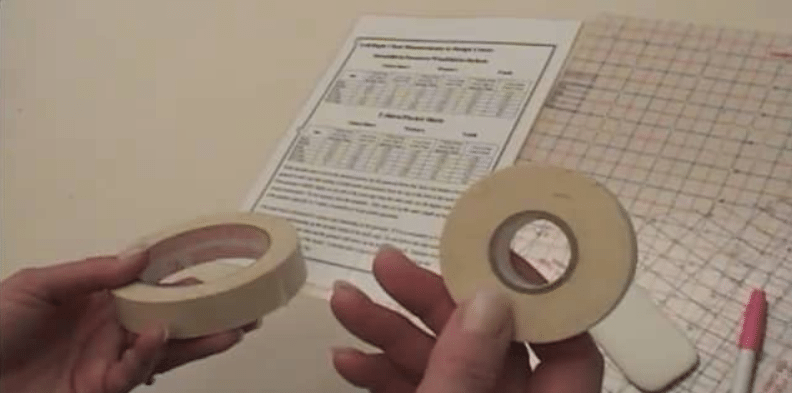
- Masking Tape
Marking tools are very important and necessary so that you can be consistent in your embroidery design placement. When you first start out you need to mark your first garment for placement using a Ruler or a Marking Grid. There are placement charts available and I furnish them to my students at the Embroidery Business Academy. These charts will give you the placement for most of your embroidery placement needs.
The tools that I have found that are the most useful for marking placement are:
- Chalk Pencil
- Air or Water Erasable Marker
- Soap
Soap is my favorite but you must be careful that it does not have any cold cream in it. I have found that the small soaps that I have picked up in hotels have worked the best, but again, do not use one that has cold cream in it. On some garments, this will leave a mark. I had this issue a couple of weeks ago. A dress shirt that had a Teflon coating on it was to be embroidered above the pocket.
The person that was hooping the shirt was new to hooping. She wanted to make sure that the embroidery was going to be straight above the pocket so she marked it and used a soap that in fact did have cold cream in it. Previous to now they had used that same soap on many fabrics without any type of issues. The finishing person wiped off the soap as normal but when she steamed the shirt it left a waxy marking line that would rub off.
As a general rule, the soap rubs off very easily on almost any type of fabric, but that was not the case with this teflon-coated fabric. After much rubbing, I was able to get that line removed. Another lesson learned, do not use a soap with cold cream in it. You must experiment with scraps to be sure that it will work on your fabrics.
The Air Erasable marker is great and was my favorite marking tool until I discovered the soap. You must be very careful though that you do not use the purple air or water erasable markers on red fabrics. Some of the brands will leave a blue line on the garment when you steam it. The purple ink in the marker reacts with the red dye in the fabric. This is also true for orange fabrics. You should not use these markers on any fabric that has red as its color base. For these fabrics use soap or a chalk pencil.
In part 4, I will talk about the supplies that you need and the actual process of hooping. After the garments are hooped they are placed in the staging area ready for the embroidery machine.
by The Embroidery Coach | | Organizing
In part 2 of this series on Organizing Your Business I am going to start talking specifically about the individual work areas or work stations within your embroidery shop. In this article I am going to start with the first area in your business after the order has taken. That area is Receiving.
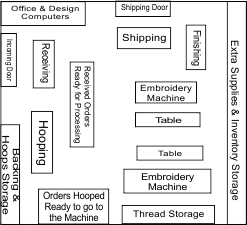
In part 1 of this Organizing Your Business series, I showed you a floor plan that is below on this page. This is a small shop with 2 embroidery machines and the square footage for this shop is about 1,000 square feet. I drew up this basic plan, but it is not drawn perfectly to scale. This plan was to show how you can lay out your shop for a good workflow and not specifically for an exact floor plan.
This is a basic floor plan that I had when I had a 6-head machine and 2 single-head machines. The single-head machines were sitting next to each other and in the floor plan, it is listed as one machine. At the time I had 5 employees, 2 machine operators, 1 hooper, 1 person finishing, and 1 person doing shipping & receiving.
It does not matter how large or how small your shop is, what matters is how you have it laid out and how many steps you are saving going from one area to another. Each one of your areas or workstations needs to be laid out in such a manner that it is physically easy for the person working in that area and efficient for the workflow.
One of the main concerns for employees is the table height that they are working at. It must be the right height for the person so that they do not have back aches and are not wasting time with the movements that are required for them to take as they are performing their tasks.
Received Orders Ready for Processing
Whether you have a large shop or a 1 person at home embroidery business, you must follow the same type of system in order to be efficient in your workflow. The first process that occurs after the order is taken is the Receiving of the order.
Your Receiving area needs to consist of a large table preferably with a back (like a short wall) built on it so that you have a place to hang your orders that are not complete in one form or another. The tools that you need for this area are a Copier or Computer and Printer and Plastic Job Folders for your orders. If you do not have a wall that you can hang the orders on, you can file them in a file box under your table.
As soon as the Order Processing is completed you are ready to Log in the Order. This is the first step in Receiving. You can Log the order in on the computer and then print out a copy daily and place it in a 3-ring binder. This binder will be stored on the Receiving desk. If you do not choose to Log in on the computer, you can create your Log in Form, print out the blank forms, and fill them in as the orders come in. If you are an embroidery shop where you have someone that receives the orders specifically, you can have them fill in the form as they receive the orders and at the end of the day, it can be input into the computer. This is the process for many small to medium-sized shops. The Login form should include the following information:
- Date (the order came in)
- Job Number
- Customers Name
- Job Name
- Item Description
- Quantity of Pieces in Order
- Process (embroidery, screen printing, twill, heat press)
- Date Due
- Date Goods Arrived from Distributor
- Date Shipped
The work order may come in from the customer by phone or email without the garments. If you are working with a Retail customer, you will be the one that is ordering the goods. The garments are shipped in separately from a distributor or manufacturer. Log the order in, assign it a job number and attach a copy of the order to a clipboard marked “Waiting for Goods”. When the Goods come in from the distributor or manufacturer, you pull out the Work Order and match it to the packing slip from the distributor. The order must match exactly.
- PO Number
- Quantity
- Item Number of the garments
- Color
- Sizes
You need to physically count all of the items and check to make sure that the color and sizes are correct and that there are no damaged goods. Notify the customer that the garments have been received and that there is a complete match or that there is a problem with the order and it is up to the customer to make whatever corrections there are to be made with the distributor or manufacturer. If it is for a Retail customer, you are the one that has to solve the problem with the distributor or manufacturer.
Design Work Can Begin As Soon As Job Is Logged In
After the goods have been successfully Logged In and even before the Goods are received the process for the design can begin. The design and sew-out can be done and approved by the customer while you are waiting for the Goods to arrive. Many times the entire job can be ready for production as soon as the goods arrive from the distributor. I will talk more about the design process in another article.
Once you have all of the information together and you have all of the correct items, place all of the information along with the order inside of a clear plastic Job Folder and tape it to the front of the box that has the goods inside of it. If there is more than one box label each box with the Order No., Job Name, and Box 1 of however many boxes in the order. It is now time to place the order in the Staging area of Received Orders Ready for Processing. At that point, the order can be picked up by the next person that is going to process that order. In the case of the Embroidery area, the next stop is Hooping. In our next article, I will talk a lot about the Hooping area. This is a big subject with lots of variables!
by The Embroidery Coach | | Embroidery Business Marketing
Creating High-Quality Sales Tools for your embroidery business will increase your sales and help save a lot of time that is normally spent working with a customer. This will also create confidence with your customers because they can see immediately the type of quality that they can expect with their finished product.
Sew Out Designs You Want To Feature
Using White felt, sew out many of your best designs and the fonts that you use the most or want to feature. When you are sewing out your designs, add a number under each design signifying the stitch count. This makes it easier when you are trying to explain to a customer about stitch count, and they can see approximately what a 10,000 stitch logo is going to look like. If you have some generic stock designs or sports symbols that you like to use, they would be a good choice.
As you are sewing out the fonts, leave enough space between each one so that they will have a neat even border. Sew each font in a different color. Use the colors of thread that you carry in stock. Sew out the main fonts that work best at a variety of sizes for you first. These will be the your standard fonts. Then you can sew out other fonts to offer as Premium fonts at a higher price. As you are sewing out the fonts, use the font name. This makes selection easier and there is no question what they are looking for.
Use Different Sizes For Your Embroidery Fonts
Choose different sizes for your fonts so that you can use this as a tool also. Example: If you sew names out in a certain font, sew that font out in the same size that you sew out a name in. That way the customer totally understands exactly what he is getting. If you have a certain size that you prefer for a left chest, sew out a block or script font that is popular for the left chest in the size that you normally use for the left chest.
After they are sewn out and trimmed perfectly, press a heat bonding material onto the back side of the embroidered sample pieces. Purchase the heat bonding material from the fabric store or an embroidery supply house.
Cut out each one of the fonts and designs using a pinked edge. To get a straight even line turn your embroidery over to the wrong side and draw a line with a ruler measuring up from the edge of the embroidery. Make sure that they all have the same amount of space around the embroidery so that they are all cut in a uniform manner.
Purchase 8 1/2″ by 11″ business card stock from the office supply store. With a hot iron or heat press machine, lay your cut pieces onto the business card stock and press them in place in a neat uniform manner.
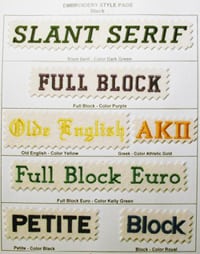
With a 3 hole punch, punch holes on the left side of the page when you are finished and place all of your sample pages into a 3 ring binder. Use one with the clear plastic storage view on the front. Create an attractive cover with your business name on it to slide into the front of the binder.
This is not a great picture but I want you to see exactly what I am talking about. Just know that this comes out looking much better than the actual photo does.
A Great Sales Tool For Your Counter
This makes a great sales tool that you can leave on the store counter or take with you. When I had my large embroidery business, I furnished each one of my dealers with a sales binder which really did increase my sales. It was very easy to use, and the customer always knew exactly what they were choosing and what type of quality they could expect.